
Take a Breath… USDA Dietary Guidelines
Take a Breath!
Let me be straight up—the release of the long‑awaited Dietary Guidelines for Americans, 2025–2030 (U.S. Department of Agriculture [USDA] & U.S. Department of Health and Human Services [HHS], 2025) took my breath away, and not in a good way. Yes, I read them while I was in Leadville, and while it’s hard to breathe at 10,200 feet, it was even harder reading what seemed like an awkward class project rather than evidence‑based public health policy.
Public health food policy requires thoughtful guidance that lives at the crossroads of food access, science, cultural sensitivity, and health equity. The new guidelines reflect little of that—and in some cases, reverse progress made over the last decade (Academy of Nutrition and Dietetics, 2025; American Society for Nutrition [ASN], 2025; The Obesity Society, 2025).
It’s not just my opinion. Multiple national organizations—the Academy of Nutrition and Dietetics, American Society of Nutrition, American Heart Association (AHA, 2022), have publicly voiced concern regarding the scientific quality and clarity of the new food pyramid.
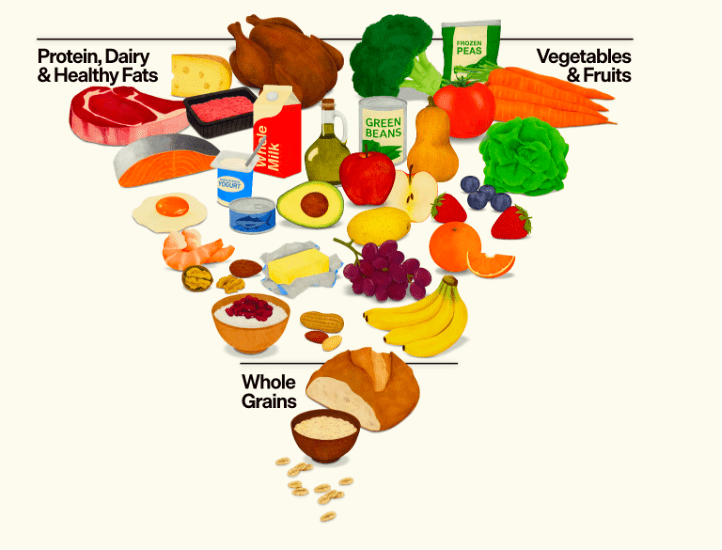
Why Does This Matter?
These guidelines shape food served in schools, childcare settings, senior centers, military facilities, and public health programs across the nation (USDA & HHS, 2025). They guide healthcare providers and dietitians in counseling patients and form the foundation for nutrition education in the U.S.
Start with the Positives
A catchy tagline— “Eat Real Food”—is simple and effective. The website realfood.gov raises awareness about the need for Americans to improve their nutrient intake. The emphasis on avoiding sugar‑sweetened beverages and alcohol is supported by long‑standing evidence linking these substances to chronic disease (American Cancer Society, 2020; Stockwell et al., 2016).
Acknowledging frozen and canned produce as valid options for increasing fruit and vegetable intake is also positive. However, many recommendations in the new guidelines deviate from evidence‑based practices and, in certain cases, may endanger specific populations.
Key Issues with the New Guidelines
1. Higher Protein Targets
Excessive protein intake can cause unnecessary weight gain in sedentary populations and be harmful to people with certain medical conditions, as an example those with chronic kidney disease, because the kidneys must work harder to excrete nitrogenous waste products (Martin et al., 2005; National Kidney Foundation, 2022).
Public recommendations should emphasize moderation and distribution of protein across plant and animal sources.
2. Limiting Carbohydrates
The recommendation to restrict overall carbohydrates overlooks the critical role of complex carbohydrates in brain metabolism, energy production, and digestive health. Research shows that adequate carbohydrate intake—especially from whole grains—supports cognitive performance and weight regulation (Gilsenan, de Bruin, & Dye, 2009; Aune et al., 2016).
3. Whole Grains
Whole grains such as oatmeal, brown rice, and quinoa contribute fiber, B‑vitamins, and phytochemicals that lower the risk of cardiovascular diseases and certain cancers (Aune et al., 2016). Guidelines suggesting only two to three servings per day fall short of the intake levels associated with optimal health benefits.
4. Saturated Fat and Animal Products
Lean meat and low‑fat dairy can fit within a balanced diet, but visible animal fat and butter should be limited. Decades of research link high saturated fat intake to increased LDL cholesterol and elevated cardiovascular disease risk (Mensink, 2016; de Oliveira Otto et al., 2012; AHA, 2022). Butter and beef tallow are saturated fats—not “healthy fats”—and should provide less than 10% of total daily calories.
5. Cereal and Fortification
Fortified cereals provide essential nutrients such as folate, iron, and B‑vitamins that help prevent deficiencies in children, women, and older adults (Fiedler, Macdonald, & Afidra, 2018). When chosen with limited added sugar, cereals can be a cost‑effective, nutrient‑dense food option.
6. Beans and Legumes
Beans, lentils, and pulses offer plant‑based protein, fiber, and minerals that improve cholesterol, lower blood pressure, and reduce cardiovascular risk (Ha et al., 2014). Including them regularly in meals supports both heart and gut health.
7. Sodium Intake
The guideline’s relaxed position on sodium is concerning. Most Americans already exceed the 2,300 mg/day limit, and high sodium intake is directly associated with hypertension and cardiovascular risk (He & MacGregor, 2009; Centers for Disease Control and Prevention [CDC], 2023). This omission undermines decades of public health progress.
8. Non‑Nutritive Sweeteners
Contrary to popular belief, non‑nutritive sweeteners are among the most rigorously tested food additives in the world. Meta‑analyses confirm they do not raise blood glucose levels and may help individuals reduce added sugar consumption (Nichol, Holle, & An, 2018).
9. Alcohol
There is no safe level of alcohol consumption. Even “moderate” drinking increases cancer risk and mortality (American Cancer Society, 2020; Stockwell et al., 2016). The new guidelines should have emphasized this unequivocally.
10. Plant‑Based Balance
An effective national diet model should highlight plant‑based proteins, fruits, vegetables, and healthy fats while moderating animal products and refined foods. Evidence consistently links primarily plant‑based diets with longer life expectancy and reduced chronic disease risk (Satija, Bhupathiraju, Spiegelman, & Hu, 2017).
Final Advice
The real “food pyramid” should prioritize plants, fiber‑rich carbohydrates, and lean proteins— not saturated fats or excessive protein portions. Political and industry influence should never outweigh decades of nutrition science (Aune et al., 2016; Mensink, 2016).
Variety, moderation, and scientific integrity remain the foundation of healthy eating patterns. As professionals, we must advocate for guideline revisions that reflect balanced, peer‑reviewed evidence and protect public health.
I’m proud to be your health care professional and will continue to offer you individualized guidance based on current science, and evidence-based practices. Open and candid communication is critical, so continue to ask questions and challenge assumptions, and choose practical, individualized nutrition strategies supported by science—not politics.
References
Academy of Nutrition and Dietetics. (2025, January 6). Academy of Nutrition and Dietetics statement on 2025–2030 Dietary Guidelines for Americans release. Retrieved January 9, 2026, from https://www.eatrightpro.org/about-us/who-we-are/public-statements/academy-statement-on-2025-2030-dgas-release
American Cancer Society. (2020). Alcohol use and cancer. Retrieved from https://www.cancer.org/cancer/cancer-causes/diet-physical-activity/alcohol-use-and-cancer.html
American Heart Association. (2022). Dietary recommendations and cardiovascular health summary report. Circulation, 146(5), e1–e27. https://doi.org/10.1161/CIR.0000000000001078
American Society for Nutrition. (2025, January 6). American Society for Nutrition calls for strong science in national nutrition guidance. Retrieved January 9, 2026, from https://nutrition.org/american-society-for-nutrition-calls-for-strong-science-in-national-nutrition-guidance/
Aune, D., Keum, N., Giovannucci, E., Fadnes, L. T., Boffetta, P., Greenwood, D. C., … & Norat, T. (2016). Whole grain consumption and risk of cardiovascular disease, cancer, and all‑cause and cause‑specific mortality: Systematic review and dose‑response meta‑analysis of prospective studies. BMJ, 353, i2716. https://doi.org/10.1136/bmj.i2716
Centers for Disease Control and Prevention. (2023). Sodium and food sources. U.S. Department of Health & Human Services. Retrieved from https://www.cdc.gov/salt/sources.htm
de Oliveira Otto, M. C., Mozaffarian, D., Kromhout, D., Bertoni, A. G., Sibley, C. T., Jacobs, D. R., & Nettleton, J. A. (2012). Dietary intake of saturated fat by food source and incident cardiovascular disease: The Multi‑Ethnic Study of Atherosclerosis. The American Journal of Clinical Nutrition, 96(2), 397–404. https://doi.org/10.3945/ajcn.112.037770
Fiedler, J. L., Macdonald, B., & Afidra, R. (2018). A food‑based approach to improving micronutrient nutrition: First results from Uganda. Food Policy, 79, 64–76. https://doi.org/10.1016/j.foodpol.2018.07.002
Gilsenan, M. B., de Bruin, E. A., & Dye, L. (2009). The influence of carbohydrate on cognitive performance: A critical evaluation from the perspective of glycaemic load. British Journal of Nutrition, 101(7), 941–949. https://doi.org/10.1017/S0007114508199019
Ha, V., Sievenpiper, J. L., Lynn, A., Jenkins, D. J., & Kendall, C. W. (2014). Effect of dietary pulse consumption on vascular health and blood pressure: A systematic review and meta‑analysis of controlled feeding trials. British Journal of Nutrition, 112(10), 1691–1702. https://doi.org/10.1017/S0007114514002634
Harvard T.H. Chan School of Public Health. (n.d.). Healthy eating plate & healthy eating pyramid. The Nutrition Source. Retrieved January 9, 2026, from https://nutritionsource.hsph.harvard.edu/healthy-eating-plate/
He, F. J., & MacGregor, G. A. (2009). A comprehensive review on salt and health and current experience of worldwide salt reduction programmes. Journal of Human Hypertension, 23, 363–384. https://doi.org/10.1038/jhh.2008.144
Martin, W. F., Armstrong, L. E., & Rodriguez, N. R. (2005). Dietary protein intake and renal function. Nutrition & Metabolism, 2(25), 1–9. https://doi.org/10.1186/1743-7075-2-25
Mensink, R. P. (2016). Effects of saturated fatty acids on serum lipids and lipoproteins: A systematic review and regression analysis. World Health Organization. Retrieved from https://apps.who.int/nutrition/publications/nutrientrequirements/fats/en/index.html
National Kidney Foundation. (2022). Protein and kidney health. Retrieved from https://www.kidney.org/atoz/content/protein
Nichol, A. D., Holle, M. J., & An, R. (2018). Glycemic and appetite responses to low‑calorie sweetener consumption: A meta‑analysis of randomized controlled trials. The American Journal of Clinical Nutrition, 108(4), 759–774. https://doi.org/10.1093/ajcn/nqy152
Satija, A., Bhupathiraju, S. N., Spiegelman, D., & Hu, F. B. (2017). Healthful and unhealthful plant‑based diets and the risk of chronic disease. Journal of the American College of Cardiology, 70(4), 411–422. https://doi.org/10.1016/j.jacc.2017.05.047
Stockwell, T., Zhao, J., Panwar, S., Roemer, A., Naimi, T., & Chikritzhs, T. (2016). Do “moderate” drinkers have reduced mortality risk? A systematic review and meta‑analysis of alcohol consumption and all‑cause mortality. Journal of Studies on Alcohol and Drugs, 77(2), 185–198. https://doi.org/10.15288/jsad.2016.77.185
The Obesity Society. (2025, January 7). The Obesity Society statement on new Dietary Guidelines for Americans. Retrieved January 9, 2026, from https://www.obesity.org/the-obesity-society-statement-on-new-dietary-guidelines/
U.S. Department of Agriculture & U.S. Department of Health and Human Services. (2025). Dietary Guidelines for Americans, 2025–2030. U.S. Government Publishing Office. https://www.dietaryguidelines.gov